THE COMMISSION : NEW BLOG ADDRESS
http://sophie4400.blogspot.com/
I have uploaded all research and ideas onto this blog address and have uploaded our set task that we were given today.
FASHION CONSTRUCTED IMAGE : NEW BLOG ADDRESS
http://sophie440.blogspot.co.uk/
have uploaded all research and ideas onto this blog address
TIME MACHINE : NEW BLOG ADDRESS
http://sophie44000.blogspot.com/
have uploaded all research, and ideas onto this blog address
WORKSHOPS: NEW BLOG ADDRESS
http://sophie4404.blogspot.com/
Saturday, 4 February 2012

Tuesday, 17 January 2012
Assessment day presentation
This is my webpage, that i presented on assessment day (13th January) It includes Environment, Body/Portriat.
http://bhons.blogspot.com/
http://bhons.blogspot.com/
Friday, 13 January 2012
self evaluations
ENVIRONMENT / LANDSCAPE SELF EVALUION
1) What is your understanding of issues related to the landscape environment?
A variety of environmental problems now affect our entire world. As globalization continues and the earth's natural processes transform local problems into international issues, few societies are being left untouched by major environmental problems. Some of the largest problems now affecting the world are Acid Rain, Air Pollution, Global Warming, Hazardous Waste, Ozone Depletion, Smog, Water Pollution, Overpopulation, and Rain Forest Destruction. I think there is so much going on in today’s world revolving around environmental concerns, and the information in newspapers serve as a great informational tool to inform the public.
2) What context would you place your work in?
During this project I was required to submit a set of images (minimum of three) based upon my personal approach of representing the landscape. Drawing upon the knowledge of my references, I had to formulate my own visual choices that best reflected how i wished to represent the landscape. I could choose if I wanted to focus on political aspects, or investigate the relationship between human interventions upon nature, or there may be ideas of the ‘cultured’ landscape that I could investigate. Whatever area I wished to work on, it was important that I considered the relationship between my visual strategy and how that affects the representation of the landscape.
When researching different issues, i loved the importance of the global issue of “oil”. I analysed the work of Burtinski, and found his photography interesting, and was intrigued how he presented his visual fascination with the world’s addiction to oil. His concept towards his photography had a massive globalisation issue. However, after research and location searching, unfortunately I didn’t have enough time to find a suitable location, and therefore began researching other themes and photographers.
After my environment tutorial, I began exploring more specific photographs related with my chosen theme ` deforestation`, and thought by researching numerous photographers it would help decide my argument towards this topic.
I researched several photographers that explored this subject, either relating back to history’s domination, the political and social issues focussing on the subject matter of a recurring theme of time, memory, human labour and development in various environmental parts of the world, the reflection upon modern city's in repeated development, and the spectacular changes in human perception. I was intrigued by all, but when thinking what context my work is placed in the idea of re-usable materials, symbolising the control that man has over landscape and are a sign of human invention on landscape, highlighting a political manner of greed for resource.
3) How did my photos translate to my initial thoughts?
I think, after my first assessment I had a lot of room for improvement, on how to show the importance of deforestation and how the theme symbolises human invention on landscape, highlighting a political manner of greed for resource. My photo’s I think, link back well towards my initial thoughts as they show how the wood can be recycled and manufactured into other useable items.
4) How have you managed your studies?
Throughout my project I have tried to manage my studies in an structured manner, including researching several photographers and suitable locations, to help develop ideas, and also have set reasonable deadlines to help achieve tasks.
5) What aspects of your shoot productions do you kneed to reflect upon and why?
Pin-pointing the location earlier enough in the day, was a crucial element as limited time was only available due to sunset. This may have given me the opportunity to experiment further with lighting and camera angles.
Researching Weather conditions was vital, as on the day of shoot there was extreme fog, and therefore was difficult to gain the perfect shot. Luckily I could manipulate this problem, with printing facilities.
6) What has been the most significant challenge on this unit so far? How can you overcome this in the future?
I think my significant challenge for this unit was finding the correct location to fulfil the requirements of the task. I think I could overcome this in the future by furthering my research to help gain a more accurate location to my thoughts in mind.
After my environment tutorial, there was room for improvement, and began exploring more specific photographs related with my chosen theme ` deforestation`, I could overcome this by researching numerous photographers, which helped decide my argument towards this topic.
Colour printing was a difficulty, as I had trouble correcting the balancing of the colour tones. I could overcome this by further practice, to hopefully gain continuity throughout my colour printing process.
self evaluations
ENVIRONMENT / URBAN CITY SELF EVALUION
1) What is your understanding of issues related to the urban city environment?
Researching about urban city environment was interesting and intriguing as political aspects, city’s potential, transformation and modernising architecture were all issues that were evident towards urban city.
2) What context would you place your work in?
For this project I was required to submit a set of images a minimum of three based upon my personal approach of representing ‘urban space’. Drawing upon the knowledge of my references, I had to formulate my own visual choices that best reflected how I wanted to represent the urban environment. This might have been political aspects that I wanted to consider, or investigate the city’s potential, or transformation and modernising architecture. I had to investigate street photography, and create a social document, or representation of humanistic scenes of urban space. Whatever area I wished to work on, I had to consider the relationship between my visual strategy and how it would affect the representation of the landscape.
For my three photographs depicting what I think embodies 'urban landscape' I chose to focus on the old and new architecture, including the effect it has on the landscape and our culture. My work reflects architectural design and futuristic styles, throughout have tried to have an interest in modern architecture, examining shapes and perspectives.
After researching for a clear understanding of what context my work was based upon, I gradually came to the understanding that not a lot has changed within city's, except modernization, and wanted to show how striking and dynamic most developments are.
3) How did my photos translate to my initial thoughts?
When thinking about ideas for my shoot I wanted to show how human invention on landscape has highlighted modernism. For an Industrial area, the Docklands have made much improvement in the last quarter century. The Docklands have shown a lot of energy, and are now able to compete with the rest of London
4) How have you managed your studies?
Throughout my project I have controlled my studies in an organisable method, by setting deadlines and researching valuable information.
5) What aspects of your shoot productions do you kneed to reflect upon and why?
On arrival at location I realised that perhaps a wide angle lens may have produced better results, as some of the areas were limited. Due to this problem, I was unable to capture certain areas. I could overcome this by practicing with camera angles. E.g. Due to limited room, standard shots were not available.
6) What has been the most significant challenge on this unit so far? How can you overcome this in the future?
On shoot day, a number of buildings were reluctant to give permission due to terrorist threats. This created a problem as I was unable to photograph certain buildings. Luckily other buildings were accessible.
self evaluations
PORTRAIT / SELF EVALUION
1) What is your understanding of issues related to the Portrait project?
This unit, The Body, aims to explore the symbol of the human body in particular, portraits.
When understanding the issues related to portraiture, I was aware that capturing a portrait is not just a basic recording of a person’s appearance, as it uses much of the same values of still life. The same use of semiotics can be applied to the portrait, to help portray a deeper and more complex story of the subject. An issue that can occur when taking portraits is not capturing the person's emotions and feelings in that moment in time, I took this fact onboard and remembered to try and gain this, in my shoot production.
2) What context would you place your work in?
For this part of the brief `the body`, our task was to photograph someone either from the local area of Medway or another student from uca who we are not meant to know. The photograph had to be taken in black and white and be taken on either using a medium or large format camera.
For my research I looked and analysed several photographers and books that helped inspire me towards my development, these were…..
Tracy Emin
Paolo Roversi
Cindy Sherman
Cecil Beaton
Sophie Calle
Valerie Belin
Phillip Toledano
Throughout the 20th century, photography and television, and even footage from the popular culture I think, have been transformed into art media. Since the 20th century photography has emerged the surrealism like the photos seen from the Cindy Sherman series. And when developing my thoughts, i wanted to look closely into glamour and what is real and not? I began researching into stereotypes for women and how they are perceived?
3) How did my photos translate to my initial thoughts?
I think my final photos translate well towards my initial thoughts, as the portrait, I think links back to my idea of reproducing a similar style as Richard Avedon's work, capturing the subject’s personality with his subtle usage of light. The photo also expresses the essence of the subject and overall brought a sense of sophistication and authority to the portrait.
4) How have you managed your studies?
Throughout my project I have tried to manage my studies in an organisable manner, including researching several photographers and suitable locations, to help develop ideas, and also have set goals and targets to help build upon tasks.
(Choose different words)…?
5) What aspects of your shoot productions do you kneed to reflect upon and why?
When thinking about what aspects of my shoot production I needed to reflect upon I thought of camera potion. When photographing my model I had trouble centring the model in the frame, I think due to the background being black I found it difficult to find the frame in the camera. I also thought the background still looked to dark, therefore moved the model forwards and increased the use of light. I think I could improve this, with further practice.
6) What has been the most significant challenge on this unit so far? How can you overcome this in the future?
Finding an appropriate model was a challenge for this unit, as the portrait had to tell the story behind the project. Developing my research into ideas was another issue, as the model I had chosen lacked in confidence and self esteem; therefore I had to come up with several ideas on how the model could project the chosen story.
self evaluations
OBJECT / SELF EVALUION
1) What is your understanding of issues related to the object project?
Through my understanding of current social issues I related my research through racism, body image related issues, homelessness, and gangs…….But the subject, obesity came to my interest.
2) What context would you place your work in?
‘The Object`, is a still life project which has allowed me to show my ability to take objects that superficially may not mean much to anybody, but when placed in context the simple objects present a sense of depth and power.
During this project we had to construct an image based on a current social issue. Elements of the idea I chose to work on was obesity.
During this project we had to construct an image based on a current social issue. Elements of the idea I chose to work on was obesity.
To begin my research I explored into the 5th century BC, where still life became known. The art form was presented as a religious and symbolic symbol relating to the objects depicted.
Throughout my research, I wanted to choose the theme of obesity and how in our looks-obsessed society, lots of people think that being overweight is an appearance issue. Due to media, and news Obesity has been proven to be a medical concern as well affecting one's health. I wanted to focus on this topic and research/learn more on how people get over weight and how, it affects today’s society.
3) How did my photos translate to my initial thoughts?
After my consultation, I felt I had room for improvement. However the photo to me portrayed everything that I wanted to capture.
This was one of my earlier projects, and since then I have learnt enormously the tasks required to take a photo shoot. And regarding one of the questions suggested about the cigarette butts, people could wonder why I have added this? Is the work now dealing with a more general theme of over eating and lack of exercise? If so, the concept and visual language strategy could be further defined, perhaps adding physical weight and a sense of sloth to the image. But the reason why I included the cigarettes was so I could highlight, everything contained in the burger is seen as unhealthy, and whilst not being politically correct, I felt the shoot went incredibly well, considering it was my first experience using all equipment.
Adding brighter colours was one of my other improvements I could have done, but in hign sight maybe my investigation could of full field my object better. I know I looked into advertisement and throughout the advertisement industry; bright colours were used to capture the mouth watering image. However I wanted to achieve the complete opposite by not making the public eat the burger, I also felt by adding brighter colours to the background, the public would be drawn more to the colours instead of the main focus point which is `the unhealthy burger`.
4) How have you managed your studies?
Throughout my project I have managed my studies in a well thought-out
Manner, including research of outside media, which helped influence my initial thoughts and hw to portray my idea, and setting goals and targets to help achieve tasks.
5) What aspects of your shoot productions do you kneed to reflect upon and why?
Originally I wanted to document the effect of obesity and how it creates a massive impact towards our everyday life.
I have always been intrigued on how obesity can change peoples lives, and was influenced by outside media e.g. Newspapers, TV, radio etc…. and photographers such as Susan Findlay, Gary Bryan …… and the painter Michael Rousseau.
I have always been intrigued on how obesity can change peoples lives, and was influenced by outside media e.g. Newspapers, TV, radio etc…. and photographers such as Susan Findlay, Gary Bryan …… and the painter Michael Rousseau.
For the shoot I wanted to create a composition that was reminiscent of an advertising campaign.
Shooting my object was quite frustrating as I could not quite get the right amount of depth of filed. For lighting I placed the source to the side of the object, in order to create definition in the object as well as creating highlights and lowlights in the composition. I also used an off- set white as the backdrop as I wanted the colour and definition to come from the object and not be overpowered by a dark background. I think I could improve this shoot, by adding more colour, thinking about re-organising my objects, and maybe researching into different surfaces that the object can be placed on e.g. taking pictures of café tables for inspiration. But overall I am pleased with the concept and the object I used, and thought the textures worked well together and whilst perhaps the colour and surface could have been better, I felt the highlight of this photo had to be the burger.
6) What has been the most significant challenge on this unit so far? How can you overcome this in the future?
After consultation, I felt I had room for improvement. However the photo to me portrayed everything that I wanted to capture.
This was one of my earlier projects, and since then I have learnt enormously the tasks required to take a photo shoot. Regarding one of the questions suggested about the cigarette butts, people could wonder why I have added this? Is the work now dealing with more general theme of over eating and lack of exercise? If so, the concept and visual language strategy could be further defined, perhaps adding physical weight and a sense of sloth to the image. But the reason why I included the cigarettes was so I could highlight, everything contained in the burger was seen as unhealthy, and whilst not being politically correct I felt the shoot a challenge but inspiring to develop more.
Adding brighter colours was one of my other improvements, but in high sight maybe my investigation could of fulfied my portrait better. I know I looked into advertisement and throughout the advertisement industry; bright colours are used to capture the mouth watering image. However I wanted to achieve the complete opposite by not making the public eat the burger, I also felt by adding brighter colours to the background, the public would be drawn more to the colours instead of the main focus point `the burger`.
Thursday, 5 January 2012


Saturday, 24 December 2011
final portrait shot
Final portrait shoot
Equipment :
Light metre reading f16 / everything in focus
Mamiya rz
Delta 100 film
Black backdrop
Beauty dish
Prolight
Before shoot day we had many portrait workshops where we experimented with lighting, expression etc.....
This is one of my contact sheets showing this....

The day for my Body shoot had finally approached, and I was nervous to say the least. My most concern was model. As soon as Josh, my assistant, had arrived we started to build the set and the lighting. I used the same light set up in previous workshops but added a new tool that I had never used before a beauty dish. As I had a simple lighting plan i was recommended to use what's called a beauty dish. When using this tool I thought it produced more abrupt shadow edge transfers better I think then using a soft box. I think overall the beauty dish produced more diffused quality of light than a standard reflector , so was perfect for my style of shoot.
Before my model arrived I did some test strips to gain confidence and understanding. I used a high aperture of f16 as I wanted everything in focus, defining all features and expression. Once contact sheets were done, luckily all I had to change was my lighting control, and where my model sat, due to shadows and a dark background. Once completed I waited for my model and began shooting.
For my second roll of film I had trouble centring the model in the frame, I think due to the background being black I found it difficult to find the frame in the camera. I also thought the background still looked to dark, therefore moved the model forwards and turned the light up.
After test shots and contact prints i finally had my final shot.
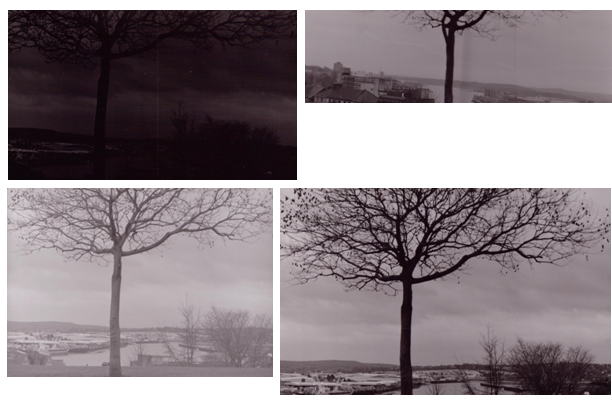
re-shoot environment/deforestation
When thinking about locations to re-shoot for my environment landscape project, I researched further into areas that showed the relationship between humans and the environment, highlighting deforestation. After travelling to different locations, I decided I wanted to shoot in the area Boxley. Whilst out on location, I came across a fencing company named Boxley Timber and Fencing Supplies. This area offered me the perfect location to shoot. Before shooting, I researched into the company and found out that they deliver all types of fencing, panels, gates, decking and garden products to the public and trade within a 30 mile radius. The company use chestnut wood to make all their supplies, which involve cutting down trees and re-using for other materials. This I think symbolises the control that man has on landscape. And think each of my images are a sign of human invention on landscape highlighting a political manner of greed for resource.
When shooting I used an Ilford 400 black and white and a 160 colour film. This enabled me to process both negatives, and conclude final images which I felt were best suited. I used a 90 standard lens and used a bronika Camera.


object / final print
After consultation, I felt I had room for improvement. However the photo to me portrayed everything that I wanted to capture.
This was one of my earlier projects, and since then I have learnt enormously the tasks required to take a photo shoot. Regarding one of the questions suggested about the cigarette butts, people could wonder why I have added this? Is the work now dealing with more general theme of over eating and lack of exercise? If so, the concept and visual language strategy could be further defined, perhaps adding physical weight and a sense of sloth to the image. But the reason why I included the cigarettes, was so I could highlight, everything contained in the burger was seen as unhealthy, and whilst not being politically correct I felt the shoot went well.
Adding brighter colours was one of my other improvements, but in high sight maybe my investigation could of fulfied my portrait better. I know I looked into advertisement and throughout the advertisement industry, bright colours are used to capture the mouth watering image. However I wanted to achieve the complete opposite by not making the public eat the burger, I also felt by adding brighter colours to the background, the public would be drawn more to the colours instead of the main focus point `the burger`.


portrait final print
After lots of research and thoughts and ideas, I came to the conclusion that I wanted to photograph women that lack in confidence and have a low self esteem. My inspiration for this, was the research based on stereotype's. I was interested in how women wanted to convey the ideal body, which made me approach this particular model. From other people I knew, she lacked confidence with her appearance, and therefore was perfect for my shoot. When meeting her, I asked questions that were based upon my idea. Through general information Nicky the model, explained her figure did not match the perfect stereotype women. She felt the only way to lift her confidence would be cosmetic surgery, which would involve a tummy tuck. This story combined well towards my research and ideas. Unfortunately, my model felt uncomfortable revealing her stomach for the shoot, and therefore I came to the conclusion of revealing her in another approach. I then looked back at previous research, and noticed the photographer Cecil Beaton captures unnoticeable hidden confused expressions, whilst forming the typical stereotype women. When arriving on shoot day, I asked Nicky to wear make-up and dress up, as I wanted her to feel comfortable with her own appearance. My idea behind this shoot was to reveal the lack of confidence in ones own body. When shooting I tried not to ask my model to portray any specific expression or pose, instead I wanted her to fell comfortable and natural, but became apparent, she obviously clamped up and formed a barrier. However I like the dream –like quality almost dreaming of the ideal appearance.


Friday, 23 December 2011
final peice / night time pastiche
On searching for location, I found the perfect shoot. However when processing my film my settings on my Mamiya RZ were incorrect for the lighting available. On this occasion, I found this to be unsatisfactory and researched further `how to shoot and obtain the perfect night time shoot`. My research showed me that bracketing was the best technique, which involved taking one picture at a given exposure, one or more brighter, and one or more darker, in order to select the most satisfactory image. This was accomplished by changing either the shutter speed or the aperture, in my case the shutter speed. I used an aperture of f22 then lowered the shutter speed each shot. I was just unfortunate that the scene had been changed and christmas eliminations had been put in place. Due to my time factor and availably of camera's, I was unable to re-shoot the pastiche. However I have gained valuable experience into night time shooting, and capturing the ideal photo first time.
This is my contact sheet and final print for the Urban environment pastiche. I went to a little street behind in Rochester high street to shoot . As this was my second time of shooting night time photography I am very pleased with the fact that I got an exposure on every frame of the film. I used a film called Ilford XP2 with an ISO of 400, and it gave a lot of detail in the darker part of the image as well as high-quality contrast. I used an exposure time from 20-24 seconds on F16 on the first five shots, and 55-70 seconds on F16 on the last five.
I think that first 5 images could have been the ones to use, given that there is a lot of reflections in the street since it was raining just before I took them. But the only problem I had due to retaking the shoot , the Rochester christmas lights had appeared and therefore don’t think captured the same effect. I also shot landscape instead of portrait which was a silly mistake, but unfortunately realised this matter after printing. Due to all these problems I am still happy with my final outcome as I learnt how to use night time photography and I still think there are some aspects in the photo that are similar to the original.
I think that first 5 images could have been the ones to use, given that there is a lot of reflections in the street since it was raining just before I took them. But the only problem I had due to retaking the shoot , the Rochester christmas lights had appeared and therefore don’t think captured the same effect. I also shot landscape instead of portrait which was a silly mistake, but unfortunately realised this matter after printing. Due to all these problems I am still happy with my final outcome as I learnt how to use night time photography and I still think there are some aspects in the photo that are similar to the original.


Wednesday, 21 December 2011
portriat research
When linking back to plastic surgery, i think the power of the cosmetic, can cause a dramtic change on todays society. When researching i found a picture that interested me and therefore researched and wrote about it.

This photograph I think focuses upon today’s society and its obsession with plastic surgery, especially among women. When it comes to physical appearance women are constantly being advertised with innovative ways to look younger, sexier, thinner, buffer and prettier. The list for perfection and the methods of achieving a certain image are immense. However, plastic surgery is the new craze that women are utilizing as a quick fix to alter their appearance.
I think when photographing her friend, in bright lighting, she wanted to make the models breasts the main focus. The model stares at her chest with a questionable face that is mixed with concern, possibly content, yet overall confusion. She was made to look as though she underwent breast augmentation and is still contemplating the results of her surgery. I think the photographer wanted the image to appear blurry and have the viewer’s gaze go directly toward her chest, as if that's the only part of being that matters.
That’s also why her eye contact is directly looking down as she makes no eye contact to the camera, due to her caught up appearance. By doing this the photographer wanted the viewer to realize that this is society telling her that her body and the way it looks is the only thing that matters.
She is unable to take note of anything else or truly realize the other components of her being, because of her initial idea of having larger breasts thinks would make her more beautiful. I think this is what society tells women. It was one of those preset values that is automatically deemed appropriate and correct for all women because society says to. Even though the model looks unpleased and unsure of her decision she went ahead with plastic surgery because she felt it necessary to be considered beautiful and to look sexier and more womanly. I think this an issue that many young girls face, and the model is able to feature the extremes they will go to, to achieve a certain look.
Not only do women suffer with the beauty of plastic surgery but also other problems such as eating disorders. Many women want to look like the perfect shape and size and therefore take maters into consideration.
This photograph I find to be the most blunt and completed in a manner that solely focuses upon the models thin frame and her still unhappy state. Her face resembles the self consciousness of her personality, signifying her disgust and desperation. Overall the photograph represents eating disorders among young girls and the pressures placed upon them by society to remain thin because thin equates to being beautiful. This photograph specifically highlights that although the model is very thin, she is still unpleased with her body and unable to cope with the idea of having a less than perfect physical appearance. She is engulfed into the idea of loosing weight and is willing to go to any extreme to do so. When viewers look at the photo I think the photographer wanted them to experience a sense of pain for her. Pain regarding the way she looks and how it is sad the extremes she has gone to, to please society. She has become so wound up in her body that she is in a state of desperation as to what to do next. This stereotype I find to be extremely prevalent in today’s society and relatable to many girls who have either experienced eating disorders themselves or have witnessed a friend or family member who has underwent such a struggle. The photographer has tried to keep the lighting bright as symbolic of a room for change and that an end to this can surface if people are willing to stand up to the demands of society.

Phillip Toledano “a new kind of Beauty”
The photographer Phillip Toledano is interested in what we as the public, define as beauty, when we choose to create it ourselves.
Beauty has always been a currency, and now that we finally have the technological means to mint our own, what choices do we make?
He questions, “Is beauty informed by contemporary culture? By history? Or is it defined by the surgeon’s hand? Can we identify physical trends that vary from decade to decade, or is beauty timeless? Perhaps we are creating a new kind of beauty. An amalgam of surgery, art, and popular culture? And if so, are the results the vanguard of human induced evolution?
When annualising these concepts I began to question “When we re-make ourselves, are we revealing our true character, or are we stripping away our identity? After thinking about this question, I began thinking ideas and how I could develop further.


portrait research /idea`s
While self portraiture can be a noble, expressive, art that comments on our social world. It can also be narcissistic if oneself is the only subject a photographer can find inspiration in.
On a personal level, I like to have my portrait taken and do feel that self-reflection is valid self-expression. However, I want my photographs to be valued for their own meaning independent from mine.

Paolo Roversi
Paolo Roversi is an Italian-born fashion photographer who lives and works in Paris. The photographer captures romantic, intense, and ethereal fashion portraits. I love his use of light, dark and the timeless quality of his pictures. He as a photographer understands that fashion is about nostalgia as well as novelty.

Cecil Beaton
Beaton is best known for his fashion photographs and society portraits. He worked as a staff photographer for Vanity Fair and Vogue in addition to photographing celebrities in Hollywood. Beaton focuses on staging and compelling a model or scene and looking for the perfect shutter-release moment. His images capture the era of the 1920`s-1930`s, and combine theatre and glamour. 
When developing my research i wanted to look closely into glamour and what is real and not? I began researching into stereotypes for women and how they are perceived? To help gain knowledge i looked at the photographer Cindy Sherman.
Throughout the 20th century, photography and television, and even footage from the popular culture have been transformed into art media. Photographic record was originally a tool and commemorative, The artists distilled the collage of the technical approach from photographic, combine objectivity of images, and makes them into personal narrative method, then emergence the surrealism photography, like Cindy Sherman.
Cindy Sherman is an American photographer and film director known for her conceptual self-portraits.
Sherman works in series, typically photographing herself in a range of costumes. For example, in her landmark 69 photograph series, the Complete Untitled Film Stills, (1977-1980) Sherman appeared as B-movie, foreign film and film noir style actresses. Sherman's most recent series, dated 2003, features her as clowns. Although Sherman does not consider her work feminist, many of her photo-series, like the 1981 "Centerfolds," call attention to the stereotyping of women in films, television and magazines.
'Untitled Film Stills`
Modelling in several roles, she reveals gender as an unstable and constructed position, which suggests, there is no innate biological female identity. On the contrary, women adopt several roles and identities depending on their circumstances. Therefore, the roles in the Untitled Film Stills series vary from an immature schoolgirl to an attractive seducer and from a glamour diva to a caring housewife. Importantly, her work encourages self-reflection in the spectator. As Sherman argues, “I’m trying to make other people recognize something of themselves rather than me.”
The premise of post modernism is that we now live in a culture so saturated with media imagery and media models of how people live that our idea of how one lives one's life and who one is, is made up of that kind of media myth. And in a sense it negates the idea of portraiture, the idea that you can dress up and go to a studio and somehow reveal your strength of character, or your inherent humanity.

But you can still dress up which is exactly what artist Cindy Sherman loved doing. She turned a familiar children's game, 'dressing up as someone else,' into art by photographing the result. In her series called 'Untitled Film Stills' Sherman created over a hundred publicity shots reminiscent of scenes from old B movies. She appears in every one as a general type you seem to recognise only all too well. In denying her own identity she also captured something of the times.

In the 1980s, Sherman introduced bright light and high-contrast colour to her work. Moving away from established female stereotypes seen in the Untitled Film Stills series, she began to deal with topics such as eating disorders, insanity and death, focusing on the consequences of society’s stereotyped roles for women rather than upon the roles themselves.
In 1984, with bright light and high-contrast colour, Sherman focuses on the consequences of society’s stereotyped roles for women — in this case as a victim of fashion — rather than upon the roles themselves.


Exaggerating her facial gestures, she models in fashionable clothes by top designers such Jean-Paul Gaultier and Rei Kawakubo of Comme des Garçons. However, she tries to show that the clothes don’t feel comfortable and attractive. woman loses her self-confidence and cannot bear the pressure of her forced role.

If we look at the image below, you notice the photo is a classic Sherman Untitled Film Still. This photo (Sherman, 1977) was taken in 1977 at the beginning of her career. The subject is located in a kitchen, at the sink. There is a pot on the stove and she's, of course, wearing an apron. This is clearly making a statement on "woman's place in the house." A few questions can be asked: why is that look on her face? is her husband out of frame berating her? why is she clutching her stomach? is she pregnant? is she hungry? These are the kinds of questions one has to keep in mind when looking at not only feminist artwork, but any artwork. You need to ask yourself why this artist has this particular staging and what it could possibly mean. The interpretation is totally up to you, you just have to look closely at what is being presented.
This photo (Sherman, 1990-91) Titled (Cosmo Cover Girl). You can simply see her social commentary. She's attacking the models you usually perceive on the covers of glamour magazines, such as Cosmo. She states: "I like making images that from a distance seem kind of seductive, colorful, luscious and engaging, and then you realize what you’re looking at is something totally opposite. It seems boring to me to pursue the typical idea of beauty, because that is the easiest and the most obvious way to see the world. It’s more challenging to look at the other side." (Sherman, 1990-91)
Here she's addressing body image. How often do you see a real woman that looks like the cover models on Cosmo? More than likely you're going to see more women that look like the one Sherman is portraying. You would never see someone who looked like this on the cover of Cosmo, but the women on the cover of Cosmo don't exist. Sherman's art is her way of fighting back against today's society.
When researching i was drawn to this image and think Cindy Sherman has tried to address no certain women identity. She's used the bright colours to give emphasis on the woman's clothing and make-up. Sherman Plays with the stereotypical woman idea and did the opposite. The character is wearing a dress made from top designers and it is not flattering to a woman's body. This then shows a woman very uncomfortable in her own skin. Cindy has also exaggerated the make-up and facial features to express her feelings of self-consciousness. The woman is being forced to look a certain way and doesn't feel too confident about it. I think the colours make the picture have more emotion. And think suggest the person is angry, uncomfortable and upset by this view of herself.
I really admire this idea, and the control over a women's self consciousness, i think i will maybe consider this stereotype as an idea and think how i could incorporate it in final developments.
In the series titled “Untitled Film Still 10″, she is the centre of attention that she strongly takes on a seemingly vulnerable role that strongly has an act of femininity. She generally thought about the conception of her images as a way of thinking of general stereotypes that Sherman was able to portray the idea of surrealism in woman due to the artificial appearances to make her images have that weirdness in them so that they look unreal to convince her audience of the awareness of it. Sherman portrayed a lot of things that in women social take serious to show their appeal with lots of make up, a lot of hair and wearing awkward clothing such as hig heels and short skirts. Sherman began experimenting with her self image, playing around with how she could make herself appear as; such as the types of personalities or characters this could conger. In the seventies, the development of feminism had made a huge impact on our society, that her work was truly influenced the way women think about themselves, that Sherman’s art and photography has hugely been successful. People wanted to reinstate themselves in the modern world and to direct the male vision away from their previous stereotypes.


After researching into stereotypes of women and how they are perceived i then began looking into feminism and how they is portrayed throughout society?
Feminism
The politics of Feminism has its own interesting journey during the past decades. Tracy Emin is the next
Tracy Emin is the next example of a diverse visual artist who explored the relationship between women and the contemporary world. From the movement of Biological Feminism to Social Construction and Post-Feminism political and social feminists, in general, seek for women’s place in the world whereas Emin finds her own ways to reflect and response to the ideas of femininity. In the picture above she explains “I’ve Got it All” which indicates the idea on how a female has surrounded her world with money. The image uses symbolism to indicate the idea of greed. Because it's a self portrait of Emin, it tells a story of her personal life to what life is like for Emin that her and money have a strong connection of her success and desire of money. It also indicates her sexual desire also judging by her clothing . Most of her work are large scaled photographs of herself, recording and expressing particular moments of emotional significance in her life, and records it as parts of her work as a photographer.

Sophie Calle is another artist who focuses on producing feminist work, but her feminism has to live with uncertainty. Calle’s piece taken from her Hotel Room series shows that the space in which the woman is in, reveals as if she is transported into an imaginary world that is beyond this world. Her work reveals sexual, voyeuristic work similar to Tracy Emin’s, and emphasizes in depth, the humour and poetry. Calle’s Hotel Room series, was produced in the 80′s. She's worked as a chambermaid in a Venetian hotel where she photographed people’s belongings as she cleaned the rooms. She then took notes of her findings and then those notes become vignettes of voyeuristic transgression, of human frailty and the mystery of private lives. She records the used towels, the slippers, the half-finished crosswords, wigs, tablets, carnival masks, and in recording she becomes almost a fictional character, an embittered, compassionate trickster figure.

Whilst researching another photogprher that i admired and who i thought linked well towards my work was Judith Golden.
In 1986: "Again and again Judith Golden has revealed her own concern about appropriate roles for herself as a woman. Her interest in problems of gender, sexuality, career, fantasy, and, ultimately, her relationship to life are themes that have never been absent from her art. Golden has become one of photography's most powerful voices of commentary on contemporary issues."
I like how she uses cut out magazines to change someone's identity an approach towards others, almost imaging the character feels self conscious and uses the mask as a screen.


After researching, i then looked into the idea of how plastic surgery can change someone's appearance and how every women desires to be the perfect appearance.
Beauty is a hot commodity on today’s market. With the price of cosmetics, clothing, perfume, cars and cosmetic surgery ever-increasing, it is no surprise that the spending power of women is increasing as well. “In spite of contemporary commentary that plays down the differences between the genders, dolls our earliest symbolic role models continue to be manufactured, marketed and purchased along gender lines.
Today the focused marketing strategies of advertisers are honing in on the money women are making, the money they are spending and how they are living. At the end of an average life-span a consumer will spend nearly three years watching or listening to advertisements. Advertising through television, print ads and radio commercials has become the norm.


” The “Buying Barbie” advertisements feature products or campaigns that target female purchasing power. Roles of women in advertising images have changed drastically over the past fifty years, no longer do we see the passive June Cleaver-like woman cleaning her kitchen, today it’s Kelly Ripa working to keep up with her busy TV career, family and home.
Advertising itself is a “mirror of social values, and a powerful, usually malicious force that shapes those values” . Mac cosmetics teamed up with Mattel and the Barbie brand to create a line of makeup that mirrors the painted face of a Barbie doll. Models donning the cosmetics of a doll, pose in the advertisement for Mac’s new line. The women in the photograph displays typical Barbie-like traits. One has bright blonde hair and rounded eyes, drooping her vibrant pink lips. The second woman is dark-skinned with black hair, sparkling green eye shadow and the same doll-like lips. Both models wear pink. Both are looking out and away from the camera, diverting their gaze upward. Each Barbie-like model is asking to be looked at. She is allowing viewers to see her face, her eyes and lips as frozen and still paintings. Their blank stares call upon the emptiness of the actual doll’s facial expression. The mortise in the upper right corner of the image reminds readers that the cosmetics, while eliciting a Barbie-feel, is actually endorsed by the Barbie brand and manufactured to purposefully look like doll-make-up. The construction of Barbie as a cultural icon “involves a dense web of products identified not only with Barbie and Mattel but also with other corporate sponsors and popular culture” Mac and Mattel make an agreement to sell, promote and distribute the image and ideals of Barbie though a joining of companies. Each benefactor profits. Mac sells makeup and Mattel promotes an image and ideal of Barbie-Beauty through product purchasing.


All celebs are role-models
In all that concerns fashion, appearance, and even life we many times refer to, all celebs are known as the ideal women. But they are humans who also can make unhealthy choices, because they feel pressured to look ‘good’ whatever it means – skinnier, flatter, tanner. And they too may suffer from complexes about appearance, weight, skin, and other stuff. Thinking that all celebs are beautiful and flawless is a mistake too, just take a look at their candid photos without all the makeup, fuss, and airbrushing. That’s what real people are all about about, the inner beauty.
Without the make-up mask, celebs can more easily disguise their identity, but when observing the photo you can see the confidence level rises when the celeb is seen in a more glamorous style. I think this shows insecurity and an unnatural look, whilst portraying a false impression. I think natural beauty should be seen as a more positive look, identifying their true character.
Many women in todays sociey like to model themselfs in a simlar way to magzine models. Here is an article that explains this....


Subscribe to:
Posts (Atom)